A Guide to the Harmonization Framework
This is a worked guide to the harmonization framework — a tool for
mapping varied source data onto a single, canonical schema with consistent
column names and consistent values. If you have CSV files that almost agree —
one calls a field full_name and another patient, one records status as A
and another as active — harmonization is the work of bringing them into line,
and this guide teaches the framework by example.
What you'll learn
By the end you'll be able to read and write harmonization rules, choose the right primitive operations for a given cleanup, and reason about the decisions that matter — when to fail on bad input versus quietly fix it, how to keep types stable across a save/load, and how to collapse several columns into one. You don't need prior experience with the framework; you only need to be comfortable reading a little Python and CSV.
How to read this guide
The chapters are meant to be read in order, starting with chapter 01. Each one is small and self-contained, built around a single idea, and later chapters assume the ideas introduced earlier:
- 01–04 build the foundations: the rule model, then numbers, text, and dates.
- 05–07 add the patterns you reach for constantly: lookups, aggregating several columns into one, and handling missing data.
- 08 is a realistic showcase that combines everything on one messy intake file.
If you're returning to look something up, the chapter list in the sidebar doubles as a reference — each chapter is named for the primitives it covers.
Before you start
The chapters run against the framework, which lives in a separate repository. Set both up as siblings:
# in a common parent directory
git clone <harmonization-framework repo>
git clone <harmonization-examples repo>

# build the framework's virtualenv
cd harmonization-framework
python -m venv venv
venv/bin/pip install -e .
This produces the layout the chapters expect:
parent/
├── harmonization-framework/   # the framework + its venv/
└── harmonization-examples/    # this repo
Every "Running it" command in the chapters uses this relative layout (for
example ../../harmonization-framework/venv/bin/python), so the two repositories
need to sit side by side.
What a chapter looks like
Chapters share a common shape, so you generally know where to look. Most follow this order, and some add a short section explaining a concept between the data and the rules:
- An introduction to the problem the chapter addresses.
- What it teaches — the primitives and ideas in play.
- The data — a small, purpose-built input table.
- The harmonization choices (and why) — each rule, with the reasoning behind it, not just the mechanics.
- The rules, serialized — the complete rule set in both JSON and YAML.
- Running it — the commands to reproduce the result yourself.
- Expected output, followed by a Data files view of the input and the golden master (rendered into this site from the committed CSV files).
Every chapter is also a self-checking test: its output is pinned to a committed golden master — an approved reference output the run is checked against — so the code you read here is code that is known to work.
The core idea, in brief
You describe a mapping as a set of rules. Each rule takes one or more
source columns and produces a single target column by running the value
through an ordered list of primitive operations. A collection of rules is a
RuleSet, saved to a rules.json (or rules.yaml) file. You define the
rules once; the Python API and the command-line tool both read that same file
and produce the same result.
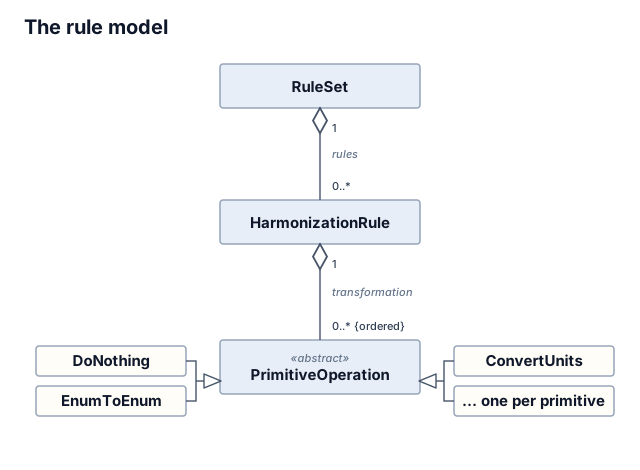
That's the whole model. Chapter 01 puts it to work on the smallest possible case — turn the page and start there.