Harmonization Examples
A layered set of chapters that introduce the harmonization framework — its rule model, its library of primitive operations, and its two interfaces (the Python API and the CLI). They are built to be read as documentation and run as self-checking tests.
The framework's job is harmonization: mapping varied source data onto a single canonical schema with consistent column names and values. These chapters are a tour of the tools it gives you for that — each one introduces a cluster of primitives on a small, purpose-built dataset, and explains why each choice was made, not just the mechanics. Start with chapter 01, which introduces the core model; later chapters build on it.
The rule model
A RuleSet is an ordered list of rules. Each rule maps one or more source columns to a single target column by running the source value(s) through a transformation — an ordered list of primitive operations (each a named primitive plus its parameters). Rules carry metadata (e.g. the rationale) alongside the mechanics. This is the whole model the chapters build on:
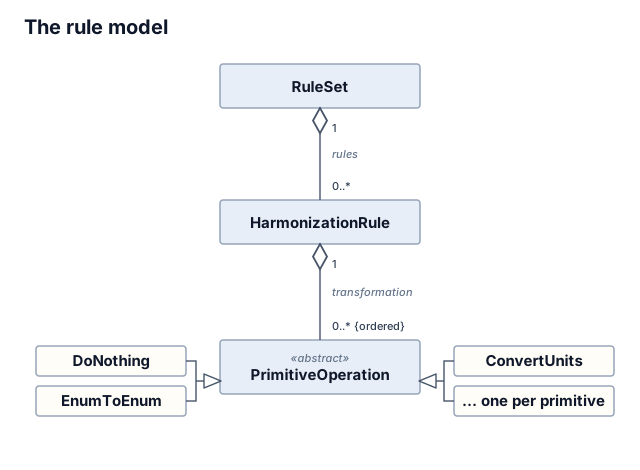
How the chapters are structured
Every built chapter expresses the same harmonization two ways, so you can enter from whichever interface you use and see that they agree:
| File | Interface | What it shows |
|---|---|---|
build_rules.py |
Python API | Constructs HarmonizationRules in code, with the rationale in comments + rule metadata, then RuleSet.save()s the rules files. The rules are defined here; the other files are generated from it. |
rules.json |
— | Generated by build_rules.py. Consumed by the CLI. Commit it so the CLI works without running Python first. |
run_python.py |
Python API | Loads the rules, harmonizes via harmonize_file, and asserts the result matches expected_output.csv. |
run_cli.sh |
CLI | Runs the harmonize CLI against rules.json — no Python needed. |
input.csv / expected_output.csv |
— | Raw input and the pinned known-good output (the golden master: an approved reference output the run is checked against). |
README.md |
— | The harmonization story for that chapter. |
Note on interface parity. The Python
harmonize_filekeeps all input columns plus the new target columns. The CLI emits only the target columns (plussource dataset/original_idwhen--include-metadatais passed). This is a real, intentional difference in the framework — each chapter's README calls out which golden master each interface reproduces.
The catalog
| # | Chapter | Status | Primitives showcased |
|---|---|---|---|
| 01 | Hello Harmonization | ✅ built | do_nothing, enum_to_enum |
| 02 | Units & Numbers | ✅ built | convert_units, scale, round, threshold, bin, format_number |
| 03 | Text & Names | ✅ built | substitute, normalize_text, truncate |
| 04 | Dates | ✅ built | convert_date (incl. fail-fast) |
| 05 | Enums & Lookups | ✅ built | enum_to_enum (strict vs. default), cast, integer-keyed maps |
| 06 | Multi-source Aggregation | ✅ built | reduce (sum/one-hot), parse_array, cast |
| 07 | Nulls & Missing-Value Codes | ✅ built | null pass-through, missing-value-code handling, --on-missing |
| 08 | Conditional & Coalescing Sources | ✅ built | case (flag-driven), coalesce (first non-null), multi-operand branches with combine |
| 09 | Clinical Intake Showcase | ✅ built | realistic blend of the above |
Running the chapters
These chapters run against the framework installed in the sibling repo's
virtualenv. From this examples/ directory:
# Python interface (also runs the golden-master assertion):
../../harmonization-framework/venv/bin/python 01-hello-harmonization/run_python.py

# CLI interface:
bash 01-hello-harmonization/run_cli.sh
Each run_python.py prints OK: ... when its output matches the golden master.